
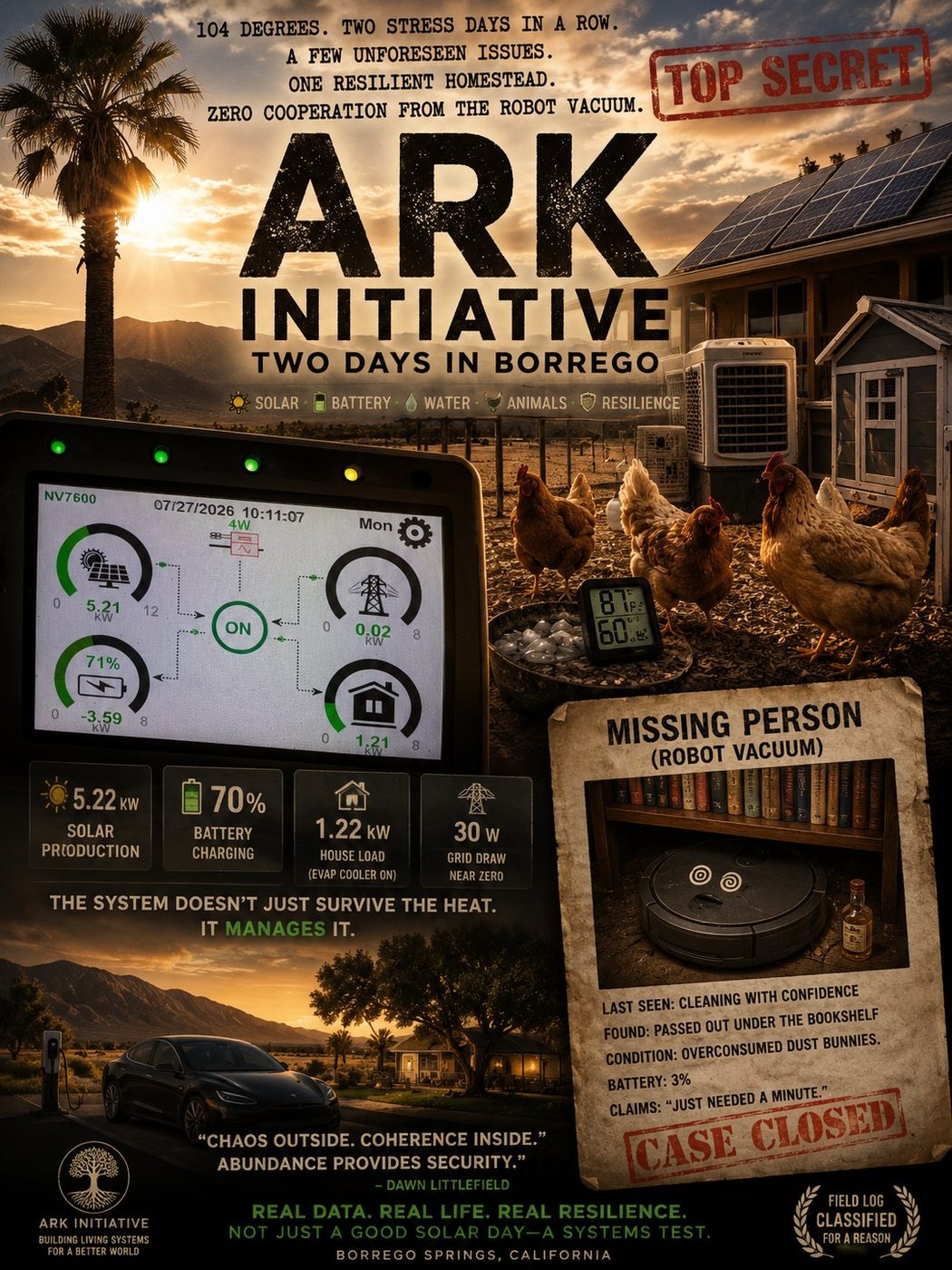
Archive context. The first proof-of-work field dossier: real Ark Unit 1 data across July 26–27, 2026 — 107.6°F heat, a battery reconfiguration, coop cooling, four hens, and one autonomous vacuum with questionable mission discipline.
ARK INITIATIVE
SYSTEMS REPORT
DAYS 55–56 IN THE BIO-ARK
Two Days in Borrego Springs, California
Engineer’s Log to the Steward
SECTION 1 OF 10 ENGINEER’S LOG TO THE STEWARDS
Location:
Ark 1, Borrego Springs, California
Observation Window:
July 26–27, 2026
Peak Recorded Ambient Temperature: 107.6°F
System Status: Operational
Observation Type: Natural disturbance and recovery following reconfiguration of inherited battery programming
The Ark had been producing electricity since June.
It had not, however, been using that energy in the correct order.
The inherited configuration allowed photovoltaic production to leave the property while the house and battery could still depend upon electricity returning through the utility grid.
The equipment was operating, but the relationship among generation, storage, household demand, and export was poorly aligned.
The configuration was changed.
Solar production would first remain within the habitat long enough to support the active house load.
Remaining production would restore the battery.
Only genuine surplus would be sent to the utility grid.
No new panels were installed. No larger inverter was added. No second battery had yet arrived.
The intervention changed priority rather than capacity.
The next two days became the first complete observation of that change: reduced solar availability, battery-supported night operation, reserve handoff, dawn collection, morning recovery, full storage, afternoon surplus, and continued production into the evening.
The same observation window also included 107.6°F heat, an electric vehicle, a coop cooling interruption, four hens, four eggs, frozen oranges, and one autonomous vacuum with questionable mission discipline.
This was not a controlled laboratory experiment.
It was an occupied habitat responding to real conditions.
The engineering question was simple:
What changes when energy is permitted to serve the place where it is produced before it is released elsewhere?
SECTION 2 OF 10
RESEARCH QUESTION AND OPERATING PHILOSOPHY
Primary research question:
How does an integrated residential desert habitat respond when locally generated energy is prioritized for household demand and battery recovery before external export?
A secondary question emerged:
Can that priority remain stable while the habitat responds to cloud cover, extreme heat, animal-care demands, and a large temporary vehicle load?
System state:
Disturbance: Natural
Intervention: Human
Recovery: Emergent
Ark Unit 1 integrates rooftop photovoltaic generation, hybrid inverter control, battery storage, utility-grid interconnection, residential cooling and refrigeration, domestic water systems, electric-vehicle charging, animal habitat support, inverter telemetry, and Rainforest utility-meter monitoring.
These are not isolated appliances.
They are parts of one inhabited system.
The revised energy priority was:
House load → battery recovery → genuine surplus export
The battery was also permitted to support the habitat after solar production ended while protecting a reserve of approximately 30%.
At that boundary, routine discharge would stop and the utility grid would assume the active house load.
The change did not merely restart a battery.
It restored the battery’s functional role within the habitat.
The operating sequence became:
Collect → Sustain → Preserve → Hand Off → Recover → Share
The Ark does not attempt to eliminate disturbance.
It attempts to preserve essential functions while moving through disturbance.
Resilience is not the appearance of uninterrupted independence. A resilient system may accept outside support when conditions require it, protect reserve before a crisis, and recover when resources return.
The purpose of this report is therefore larger than measuring solar production.
It is to document whether the relationships among generation, storage, environment, animals, machines, and human attention remained coherent under real desert conditions.
SECTION 3 OF 10
METHODS, DISTURBANCE, AND NIGHT SUPPORT
Observations were assembled from NV7600 inverter displays, battery state-of-charge readings, mobile application records, Rainforest utility-meter data, photographs, direct environmental inspection, and animal-behavior observations.
Displayed values were recorded during normal operation rather than through calibrated laboratory instrumentation.
The inverter, utility monitor, vehicle application, cameras, and mobile devices may not share a verified synchronized clock. Images taken near one another should not automatically be interpreted as perfectly simultaneous measurements.
Day 55 began under persistent cloud cover.
Photovoltaic production was reduced while normal habitat demands continued. Cooling remained active. Refrigeration, water systems, communications, animal care, and ordinary household activity did not pause simply because the sky changed.
The system was not placed under artificial stress.
The disturbance arose from ordinary desert weather interacting with an occupied home.
By 19:47 on July 26, solar production had ended and the battery had assumed the primary electrical load.
Observed state:
Battery state of charge: approximately 86%
Battery output: approximately 1.43 kW
House load: approximately 1.29 kW
Solar production: 0 kW
Grid contribution: negligible
The battery was carrying the habitat as intended.
This was the first important confirmation of the revised programming. Energy gathered earlier in the day remained available after sunset and supported the occupied structure rather than being treated only as a commodity for immediate export.
The electrical value was modest.
Its purpose was not.
That load represented cooled rooms, refrigeration, circulating water, communications, lighting, animal support, and continuity through a hot desert night.
The inverter saw approximately 1.29 kW.
The habitat experienced shelter, preservation, and time.
SECTION 4 OF 10
PROTECTED RESERVE AND CONTROLLED HANDOFF
At 03:53, the battery reached its protected reserve.
Observed state:
Battery state of charge: approximately 30%
House load: approximately 1.12 kW
Grid supply: approximately 1.12 kW
Solar production: 0 kW
At the configured boundary, the battery stopped carrying routine household demand.
The utility grid assumed the load without interruption.
Cooling, refrigeration, communications, and other essential functions continued.
This was not a depletion event.
It was a controlled handoff.
A system that spends every reserve merely to appear independent may look impressive briefly, but it is not necessarily resilient.
Protected capacity has value precisely because it is not consumed during ordinary operation.
The 30% reserve established a functional boundary between routine self-consumption and preserved emergency capability.
The grid’s participation did not erase the work of the battery.
The battery had already carried the habitat through the night.
The grid then accepted the load when the protected threshold was reached. Each component performed its assigned role.
This sequence matters because resilient systems are often misunderstood as systems that never need outside help.
That is not the standard being tested here.
The more useful standard is whether the habitat can:
use local energy while it is available,
protect critical reserve,
transfer load without disruption,
and recover when environmental conditions improve.
During this observation, the handoff was orderly.
No essential function was lost.
No reserve was sacrificed for appearance.
The Ark moved from stored support to external support without treating either condition as failure.
Night support → reserve protection → grid handoff
The next phase would begin shortly after dawn.
SECTION 5 OF 10
DAWN COLLECTION AND MORNING RECOVERY
Solar collection began shortly after dawn.
As production increased, the revised dispatch order became visible. Solar first supported the active house load. Remaining production moved into the battery. Grid participation fell toward zero.
Documented recovery sequence:
06:52
Solar 1.17 kW; battery 29%; charging 0.17 kW; house 1.01 kW; grid import 0.07 kW.
08:00
Solar 2.24 kW; battery 34%; charging 1.26 kW; house 1.01 kW; grid import 0.04 kW.
09:02
Solar 4.01 kW; battery 47%; charging 2.82 kW; house 0.88 kW; grid import 0.02 kW.
10:11
Solar 5.21 kW; battery 71%; charging 3.59 kW; house 1.21 kW; grid import 0.02 kW.
11:09
Solar 5.76 kW; battery 89%; charging 1.53 kW; house 0.99 kW; grid export 2.71 kW.
11:34
Solar 5.92 kW; battery 94%; charging 1.53 kW; house 1.35 kW; grid export 2.49 kW.
12:18
Solar 6.06 kW; battery 100%; house 1.16 kW; grid export 4.18 kW.
13:48
Solar 5.83 kW; battery 99%; house 1.17 kW; grid export 3.93 kW.
Operationally, the battery had entered strong recovery by approximately 10:00 a.m.
The timestamped record shows 71% at 10:11 and full charge at 12:18.
That distinction is important.
“Recovered by morning” describes the habitat’s practical operating pattern.
“Full at 12:18” describes the documented measurement.
The sequence is more informative than any single peak value.
The house was served first.
Storage was rebuilt second.
Substantial export appeared only after internal demand and recovery were satisfied.
Nothing new had been added.
The order had been corrected.
SECTION 6 OF 10 AFTERNOON HEAT, EVENING PRODUCTION, AND STORAGE LIMITS
At 12:18, the revised configuration reached its clearest documented expression:
Solar production: approximately 6.06 kW
Battery state of charge: 100%
House load: approximately 1.16 kW
Grid export: approximately 4.18 kW
At 13:48, production remained high:
Solar production: approximately 5.83 kW
Battery state of charge: 99%
House load: approximately 1.17 kW
Grid export: approximately 3.93 kW
The strongest heat of the day arrived around 3:00 p.m.
That timing matters.
The system was not merely producing strongly at noon and fading before the habitat’s most demanding thermal period. Field observation indicates that solar remained useful through the afternoon and continued producing until shortly before 9:00 p.m.
The available timestamped readings do not yet establish the exact production curve or daily electrical peak. They do show near-maximum output in the early afternoon. Repeated observation places the period of strongest environmental heat around 3:00 p.m., while useful photovoltaic collection continues for many hours afterward.
The resulting daily rhythm is broader than a single “solar noon” event:
Dawn collection → morning recovery → afternoon heat support → evening production → battery-supported night
Panel orientation, roof angle, seasonal sun position, and local shading may contribute to the long production window.
Additional synchronized readings are needed before the precise electrical peak can be formally established.
Under the observed conditions, photovoltaic generation exceeded both active household demand and available storage demand.
Once the battery was full, approximately 4 kW remained available for export.
The limiting resource had shifted.
It was no longer generation.
It was the amount of energy the habitat could retain.
SECTION 7 OF 10
VARIABLE LOAD EVENT:
ELECTRIC VEHICLE CHARGING
A Tesla was connected during the broader recovery period.
The vehicle application displayed:
Charging current: 24 A
Voltage: approximately 239 V
Charging power: approximately 5 kW
Vehicle state of charge: 47%
Energy added: approximately 17 kWh
Charge limit: 90%
The vehicle represented a major controllable load.
Its charging demand was comparable to most of the photovoltaic production available during the morning recovery window and several times larger than the observed household load of approximately 1–1.3 kW.
This made charging current a system-level control.
Duration alone does not describe the operational impact of electric-vehicle charging. A vehicle connected longer at a restrained current may interfere less with battery recovery than a shorter session at a high current.
The available photographs do not establish exact synchronization between the Tesla application and inverter display. They should therefore be interpreted as evidence from the same broader operating period, not necessarily as perfectly simultaneous measurements.
Even with that limitation, the event exposed a clear capacity boundary.
The system could support the house, rebuild the battery, and charge the vehicle.
It could not necessarily maximize all three activities at the same moment without temporary grid participation.
That was not failure.
It was the habitat showing where its current limits are.
A controllable load becomes useful when it can respond to the state of the wider system.
Future vehicle-charging trials should compare multiple current settings against solar production, battery state of charge, house load, ambient temperature, and grid interaction.
The objective is not simply to charge as quickly as possible.
It is to charge at the rate the habitat can absorb without compromising more important functions.
SECTION 8 OF 10
STEWARD’S OBSERVATION: COOP COOLING INTERRUPTION
Character count: 1,994
The electrical recovery occurred during extreme desert heat.
Peak recorded ambient temperature reached 107.6°F, with the strongest heat occurring around 3:00 p.m.
The chicken habitat relied upon structural shade, an evaporative cooler, water supply, drinking water, ice, frozen containers, chilled fruit, and direct human monitoring.
During the event, the hens’ vocalizations changed.
The altered sound prompted camera review and physical inspection.
The water supply serving the evaporative cooler had been interrupted.
The cooler had not independently reported the failure.
The animals did.
Corrective action included restoring the cooler’s water supply, adding ice to available water, using frozen bottles and cooling materials, providing chilled oranges, and continuing direct behavioral observation.
The hens were subsequently photographed standing, feeding, drinking, and gathering near the restored cooling area.
Special attention was given to Henryette, the oldest hen.
Four eggs were found during the observation period.
The eggs should not be presented as proof that the intervention caused immediate physiological recovery or increased productivity.
They are recorded more cautiously as evidence that laying activity continued within the broader period despite the preceding thermal stress.
The scientifically supportable observation is:
Following restoration of water and cooling support, the hens remained active and engaged with food, water, and their environment during the documented period.
This event also revealed a monitoring gap.
The electrical system could show how much power the habitat consumed.
It could not explain whether water was reaching the cooler or whether the animals were experiencing distress.
Animal behavior functioned as a sensor.
Human attention completed the circuit.
The inverter sees kilowatts.
The Ark must learn to see whom those kilowatts are keeping alive.
SECTION 9 OF 10 MONITORING, MAINTENANCE, AND UNEXPECTED FINDINGS
The Ark used two principal electrical monitoring boundaries.
The NV7600 inverter documented energy circulating inside the solar-storage system: photovoltaic production, battery charge and discharge, house demand, and instantaneous grid interaction.
The Rainforest monitor documented activity at the utility meter: energy crossing the meter, purchased energy, credited or exported energy, and estimated monetary value.
A photographed display showed approximately 137.4 kWh and $23.37 in one recorded direction, and 49.7 kWh and $8.36 in the other.
The precise billing labels and measurement interval require verification before formal publication.
The two instruments do not measure the same thing.
The inverter describes internal flow.
The Rainforest device describes external exchange.
Together, they provide a fuller account than either can alone.
Maintenance performed before or during the observation included cleaning photovoltaic panels, trimming vegetation affecting solar access, and replacing the Rainforest communication cable.
These actions did not increase installed capacity.
They recovered access to capacity already present.
A system may appear undersized when its performance is being reduced by dirt, shade, communication failure, inherited programming, or avoidable operational friction.
Before purchasing new hardware, lost capacity should be identified and recovered.
Unexpected findings included:
Dispatch priority changed whole-system behavior without adding generation.
The protected reserve improved continuity rather than preventing useful battery operation.
Animal vocalization identified a cooling failure before the available instruments did.
Vehicle charging current became a habitat-level control.
Full storage revealed surplus generation.
Useful solar production persisted well beyond noon and toward evening.
Noncritical Autonomous Systems Note
The robotic floor-cleaning unit temporarily failed to report for duty.
It was located beneath a bookshelf at approximately 3% battery.
No measurable effect on habitat continuity was observed.
Wider conclusions regarding autonomous motivation are not recommended.
I don't think he enjoys his job.
We will talk about transferring him to another department. Why do I say he? He hates cleaning and hides like a teen boy when told to clean - so it stuck.
I have OCD.
Quiet quitting technology is a problem 😁
SECTION 10 OF 10 INTERPRETATION, RECOMMENDATION, AND CONCLUSION
Within the limits of this event, Ark Unit 1 maintained essential functions through natural disturbance and returned to full stored capacity when conditions improved.
The habitat did not remain perfectly balanced.
It moved through imbalance in an orderly sequence.
The battery carried the night load.
The reserve boundary was respected.
The grid provided temporary support.
Solar began collecting after dawn.
The battery entered strong recovery during the morning and reached documented full charge at 12:18.
The strongest heat arrived around 3:00 p.m.
Solar remained useful through the afternoon and continued until shortly before 9:00 p.m.
Meanwhile, human observation identified and corrected a biological-support failure that electrical telemetry alone could not reveal.
Resilience did not arise from one exceptional component.
It emerged from the relationship among generation, storage, grid support, environmental control, maintenance, animal behavior, and human attention.
This dossier documents one naturally occurring event. Its limitations include displayed rather than calibrated instrumentation, incomplete clock synchronization, limited coop temperature and humidity records, observational rather than veterinary animal assessment, and insufficient repeated measurements to establish a precise daily solar-production curve.
The evidence supports continued study, not universal claims.
Engineering recommendation:
Additional storage would likely provide greater operational value than additional photovoltaic generation under the observed conditions.
A second battery could extend overnight self-consumption, shorten grid handoff, absorb more afternoon surplus, improve coordination with vehicle charging, and preserve greater usable reserve during extended cloud events.
A second battery would not repair a failed system.
It would increase the amount of continuity the system can hold.
The Ark did not avoid disturbance.
It preserved essential functions, accepted support when required, protected reserve, and recovered when conditions allowed.
The habitat was served.
The reserve was rebuilt.
The surplus was shared.
The inverter records the flow of energy.
The Ark records what that energy keeps alive.
Prepared by:
Dawn Littlefield
Commander, Ark Initiative
Ark Unit 1
Borrego Springs, California
Real data. Real life.
Real resilience.
The future is not controlled.
It is cultivated.
#ArkInitiative #BioArk #FieldDossier055 #LivingSystems #DesertResilience Part 7