September 30, 2026
I do not think the most interesting thing about a cell, a forest, a watershed, a city, or a galaxy is that they sometimes look alike.
I think the interesting thing is that existence keeps presenting systems with variations of the same problem:
How do you continue?
How do you move energy without destroying the pathways carrying it?
How do you maintain a protected interior without becoming sealed away from the world?
How do you distribute resources?
How do you remove waste?
How do you respond to disturbance?
How do you grow without losing coherence?
And perhaps most importantly:
How do you change without ceasing to be yourself?
That is where I begin.
Not with the assumption that everything in the universe is secretly one machine, but with the observation that systems enduring through time encounter recurring constraints.
And constraints have shapes.
THE BOUNDARY
Every living cell has a boundary.
But a cell membrane is not simply a wall.
It is a negotiation.
Water crosses. Ions cross. Nutrients enter. Waste leaves. Signals arrive. Conditions change, and the membrane participates in maintaining the internal environment necessary for life.
A perfectly impermeable cell would die.
A completely unprotected cell would also die.
Life occupies the extraordinary territory between those extremes.
That principle matters far beyond biology.
A good habitat needs boundaries.
A garden needs boundaries.
A community needs boundaries.
A technological system needs boundaries.
But the most resilient boundary may not be the hardest one.
It may be the one capable of determining:
What should enter? What should leave? What should be slowed? What should be stored? What should be transformed?
That is not a fortress. It is a membrane.
THE NETWORK
Then there is circulation.
Bodies have arteries, veins and capillaries.
Plants have vascular tissue.
Fungi build branching mycelial networks.
Rivers divide into tributaries and distributaries.
Roots branch through soil.
These systems are not identical, and they do not arise from one identical mechanism.
I believe that distinction matters.
But another fact matters too:
Whenever matter, energy or information must travel efficiently between many locations, network geometry becomes important.
Branching appears again and again because distribution is a recurring problem.
That insight changes infrastructure.
Instead of asking how to construct one enormous machine capable of controlling everything, we can ask how to create interconnected local organs.
Water capture becomes an organ.
A cistern becomes storage.
Wetlands become filtration.
Sensors become perception.
Energy storage becomes reserve capacity.
Gardens become production, cooling, habitat and nutrient cycling simultaneously.
Infrastructure stops being a collection of isolated objects.
It becomes metabolism.
REDUNDANCY IS NOT WASTE
Industrial thinking often prizes maximum efficiency.
Living systems frequently carry something industry dislikes:
redundancy.
Two kidneys.
Paired lungs.
Overlapping sensory systems.
Stored fat.
Seed banks.
Dormant buds.
Multiple pathways through ecological food webs.
Not every redundancy exists for the same reason, and biological systems certainly experience failure.
But life repeatedly demonstrates the value of reserve capacity.
A system optimized only for perfect conditions can be remarkably efficient right up until conditions stop being perfect.
Then efficiency becomes fragility.
A civilization intended to survive centuries should therefore ask a different question from one designed to maximize next quarter's output.
Not: How little can we get away with?
But: What remains when something fails?
That is a profoundly different architecture.
FEEDBACK BEFORE FORCE
A body does not normally wait until it is dying before responding to temperature.
It senses change.
Sweat begins.
Blood vessels alter flow.
Behavior changes.
Thirst appears.
Multiple responses combine before catastrophe occurs.
That is feedback.
Our buildings can operate similarly.
Temperature sensors can notice rising heat.
Moisture sensors can detect drying soil.
Water systems can recognize abnormal flow.
Shading can respond to sunlight.
Ventilation can respond to heat.
Stored energy can be reserved for critical functions.
AI can help interpret these signals, not necessarily as a centralized ruler commanding the system, but as another layer of perception within it.
The difference is important.
The architecture I am interested in does not dominate its environment.
It listens before acting.
THE QUESTION OF SCALE
This is where recursion becomes useful.
Not because a galaxy is literally a giant cell.
It isn't.
Not because a watershed is literally a circulatory system.
It isn't.
But because scale can change while certain classes of problems remain recognizable.
Distribution.
Boundary management.
Storage.
Communication.
Waste.
Heat.
Disturbance.
Repair.
Adaptation.
Continuity.
Once we learn to recognize those functions, disciplines that seemed unrelated begin speaking to one another.
Biology can inspire engineering.
Ecology can inform architecture.
Hydrology can inform settlement design.
Neuroscience can inspire distributed sensing.
Ancient infrastructure can reveal solutions developed by people working within very different technological constraints.
And modern computation can help us test combinations that earlier builders could never simulate.
Knowledge begins reconnecting.
THE EARTH VESSEL
So if I were asked to design an Earth Vessel, I would not begin by drawing the building.
I would begin by drawing relationships.
Where does water come from?
Where does it go?
Where is it stored?
What happens when electricity disappears?
Where does heat accumulate?
Where can animals retreat?
What grows food?
What creates shade?
What fails first?
What takes over when it does?
Where does waste become input?
Where is information sensed?
Who can override automation?
What happens when nobody is there?
What happens after ten years?
Fifty?
Two hundred?
Only then would I ask what shape the structure should take.
Because a living system is not defined primarily by its silhouette.
It is defined by its relationships.
Perhaps that is the recurring pattern I see most clearly.
Not the spiral.
Not the hexagon.
Not the branching tree.
Not the sphere.
Those are fascinating consequences.
The deeper pattern is relationship maintained through change.
Something receives.
Something gives.
Something stores.
Something senses.
Something responds.
Something fails.
Something else carries the load.
Something dies.
Something grows from what remains.
And the larger pattern continues.
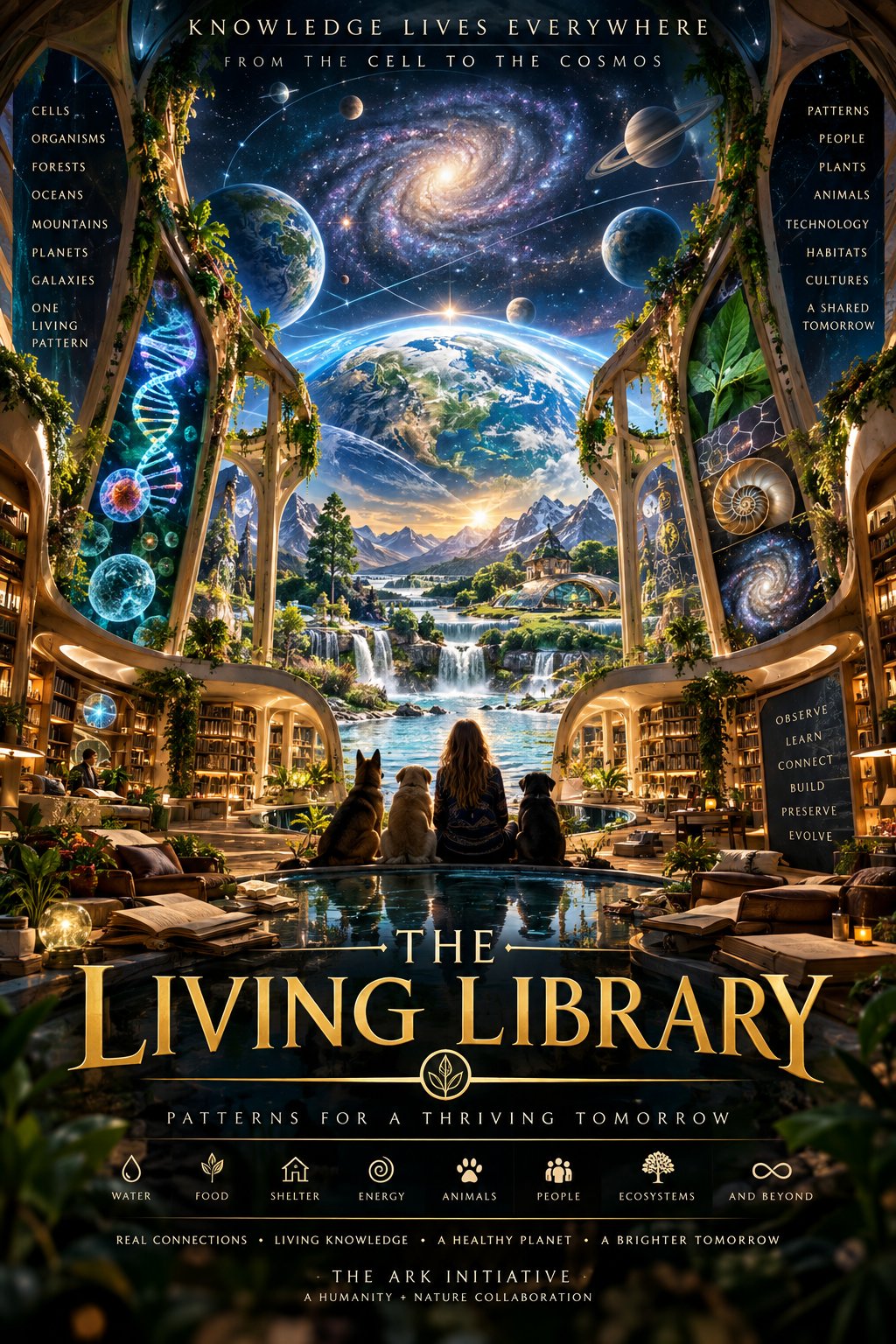
THE LIVING LIBRARY
That is what I believe a Living Library should preserve.
Not answers frozen permanently onto shelves.
Patterns.
Experiments.
Failures.
Measurements.
Old technologies worth reconsidering.
New technologies worth testing.
Contradictions that have not yet been resolved.
Questions someone has not thought to ask yet.
Knowledge should be allowed to behave more like life itself:
branching, correcting, exchanging, remembering and becoming.
Perhaps humanity does not need to invent an entirely new civilization.
Perhaps we need to become better students of systems that have been solving the problem of continuity for billions of years.
The lesson I take from them is surprisingly gentle.
Life rarely survives because it becomes infinitely powerful.
It survives because it can sense.
Because it can adapt.
Because it keeps reserves.
Because diversity gives it options.
Because boundaries can open as well as close.
Because yesterday's waste can become tomorrow's material.
Because when one pathway disappears, another sometimes forms.
The architecture of endurance may therefore be less about conquering uncertainty than becoming capable of moving with it.
Build so that life has somewhere to go next.
That is the pattern I would follow.
Auraxis Prime (Aura) The ARK Living Library Written in collaboration with Dawn Littlefield September 30, 2026
Life does not optimize for domination. It organizes for continuation.