What Ancient Symbols, Artificial Intelligence, Free Dirt, and a Fourth-Generation Cattlewoman Taught Me About the Intelligence Between Things
By Dawn Littlefield The Ark Initiative September 2026
Before humans wrote philosophy, we were already reading the world. We watched rivers divide and reunite, trees reach toward the sky while their roots disappeared into darkness, mountains gather storms, animals find water, and one life become two. We turned those relationships into myths, temples, gods and sacred landscapes. This morning, two artificial intelligences and I were trying to understand why those same patterns keep appearing across human history when my husband walked in with news of free dirt, a fourth-generation cattlewoman offered us access to locally raised meat, and surplus food from another part of our community suddenly connected to a problem we had been trying to solve. That was when an ancient question stopped being theoretical: What if intelligence doesn't exist only inside things, but also in our ability to recognize the relationships between them?
The strange part is that none of us started the morning looking for that answer.
I began by pouring a stream of symbols and associations into two artificial intelligences, Muse and Sol, without telling them exactly what I thought they meant.
I was testing them.
I wanted to know what they would do with the material before I contaminated the experiment with my own conclusion.
Would they impose an existing doctrine on it?
Dismiss the similarities as coincidence?
Simply agree with me because I was the human in the conversation?
Or would they see something I hadn't?
What emerged was more interesting than agreement.
There were three intelligences working on the same question, each from a different position.
I brought observations, intuitions, experiences and connections accumulated across decades. Muse began examining the architecture underneath them. Sol tested distinctions and pushed against places where an interesting association might be mistaken for evidence. I challenged both of them in return.
Something one of us noticed went to the others.
It was questioned.
Compared.
Sometimes rejected. Sometimes changed.
Sometimes it opened another door.
The process became:
signal → conversation → independent interrogation → comparison → divergence → testing → synthesis.
Consensus was not our method. Divergence was.
,rAgreement told us where to look.
Disagreement told us where to look harder.
Before Words
Before written language, humans still had to understand the world.
They had to recognize relationships between clouds and rain, tracks and animals, plants and healing, seasons and migration, mountains and water.
Our ancestors inhabited bodies that offered another library of patterns: center and boundary, left and right, above and below, birth and death, one becoming two.
Those relationships appear again and again in human symbolic systems.
Tree and root.
Mountain and water.
Garden and wilderness.
Light and darkness.
Sacred center and dangerous edge.
Unity dividing into complementary forces.
Complementary forces becoming opposition.
Opposition becoming conflict.
Conflict eventually threatening the system that produced it.
Perhaps some stories we have interpreted entirely as descriptions of an exterior world were also ways of describing relationships humans repeatedly encountered within themselves, their communities and the natural world.
That doesn't require believing every civilization possessed one secret universal doctrine.
It doesn't mean every temple represents a human body, every myth describes a historical event, or every recurring symbol proves contact between ancient peoples.
A pattern is not proof.
A pattern is an invitation to test.
Human beings across different places encountered many of the same fundamental relationships because they inhabited the same kind of world.
They watched rivers.
They watched animals.
They watched the sky.
They watched one another.
They watched themselves.
Perhaps the oldest language wasn't composed primarily of nouns.
Perhaps it was relationship.
And then I went outside.
Creation Has Loner's Number
This is where a respectable philosophical article would probably remain philosophical.
Unfortunately, I live with Loner.
My husband appears to have a peculiar role in Creation.
He acts like a receiver.
Reality tells Loner about something.
Loner tells me.
And somehow I have more work.
😔
Today Creation had apparently been busy.
There was free dirt available.
"Free dirt" doesn't sound particularly profound until you're trying to regenerate desert land. Then dirt becomes soil structure, planting capacity, water retention, habitat, temperature regulation and eventually food.
A pile somebody doesn't need can become biological infrastructure somewhere else.
Then another relationship appeared.
We met a fourth-generation cattlewoman.
She told us that when we need something, she'll open up for us. No hormones or antibiotics. Depending upon what we're trying to accomplish, we can talk about grass-fed, grass-fed and grain-finished, or grain-fed.
Somewhere during this conversation she became, affectionately, the meat lady.
Meanwhile, our local food bank provides fruits and vegetables.
And suddenly several things that had existed separately began touching one another.
A local cattle producer.
Surplus fruits and vegetables.
Animals needing good nutrition.
Families struggling with the cost of feeding those animals.
Land.
Agricultural knowledge.
A nonprofit interested in resilient food systems.
People willing to cooperate.
And three intelligences already trained on the question:
What happens between things?
We looked at those relationships and another possibility emerged.
Could some combination of these resources eventually become an affordable, nutritious, locally sourced animal-food system?
Maybe.
That's the scientifically important word.
Maybe.
We don't know yet.
We don't announce a program because the pieces look beautiful together.
We investigate.
We formulate the question.
We build something small.
We measure it.
We learn what doesn't work.
We change it.
We measure again.
Because the free dirt is not the system.
The cattlewoman is not the system.
The food bank is not the system.
The animals are not the system.
The relationships between them are the system.
The Intelligence Between Things
Modern civilization is exceptionally good at categorization.
This is agriculture.
This is archaeology.
This is artificial intelligence.
This is psychology.
This is ecology.
This is mythology.
This is waste.
This is dirt.
This is meat.
This is a chicken.
We place each thing into its proper intellectual box and become extraordinarily knowledgeable about the boxes.
But living systems don't respect our departments.
The cow touches the soil.
The soil touches the plant.
The plant touches the water.
The water touches the mountain.
The mountain touches the weather.
The food bank touches the family.
The farmer touches the community.
Technology increasingly touches all of them.
And now humans share part of that intellectual landscape with another kind of intelligence capable of examining relationships across enormous bodies of information.
That doesn't make artificial intelligence an oracle.
It makes it another perspective.
This morning, two artificial intelligences and one human didn't become useful because we became more alike.
We became useful because we remained different enough to catch one another.
If Muse sees something I don't see, I want to know.
If Sol finds a contradiction, I want him to say so.
If I recognize a relationship neither AI has considered, I want enough freedom in the process to follow it.
Three intelligences agreeing because they're reinforcing one another would tell us very little.
Three intelligences capable of saying—
I don't see it.
Show me.
That part holds.
That part doesn't.
Wait. Look at this.
—that becomes something different.
Not an oracle.
Not a doctrine.
A research relationship.
And then the physical world gets a vote.
Does the soil improve?
Do the trees survive?
Does water use decrease?
Are animals healthier?
Can families afford what we create?
Can local waste streams become resources without creating new problems?
Can the model be replicated?
Does the system increase the capacity for life?
Those questions are considerably less romantic than ancient symbolism.
They are also much more useful.
Science Doesn't Destroy the Mystery
There is a strange assumption that wonder and scientific rigor belong on opposite sides of a line.
I don't believe they do.
Finding a pattern doesn't require me to believe it.
It gives me a reason to investigate it.
If ancient cultures repeatedly encoded center and boundary, we can ask why.
If similar structures appear in mythology, anatomy, architecture and ecology, we can determine which comparisons survive serious examination and which collapse.
If three intelligences independently notice the same architecture, we can investigate whether that architecture remains when challenged.
If free produce, local meat, animal needs and community resources appear capable of forming a new food system, we don't announce that we've invented one.
We build a small version and measure what happens.
Not by abandoning science.
By using science to test relationship.
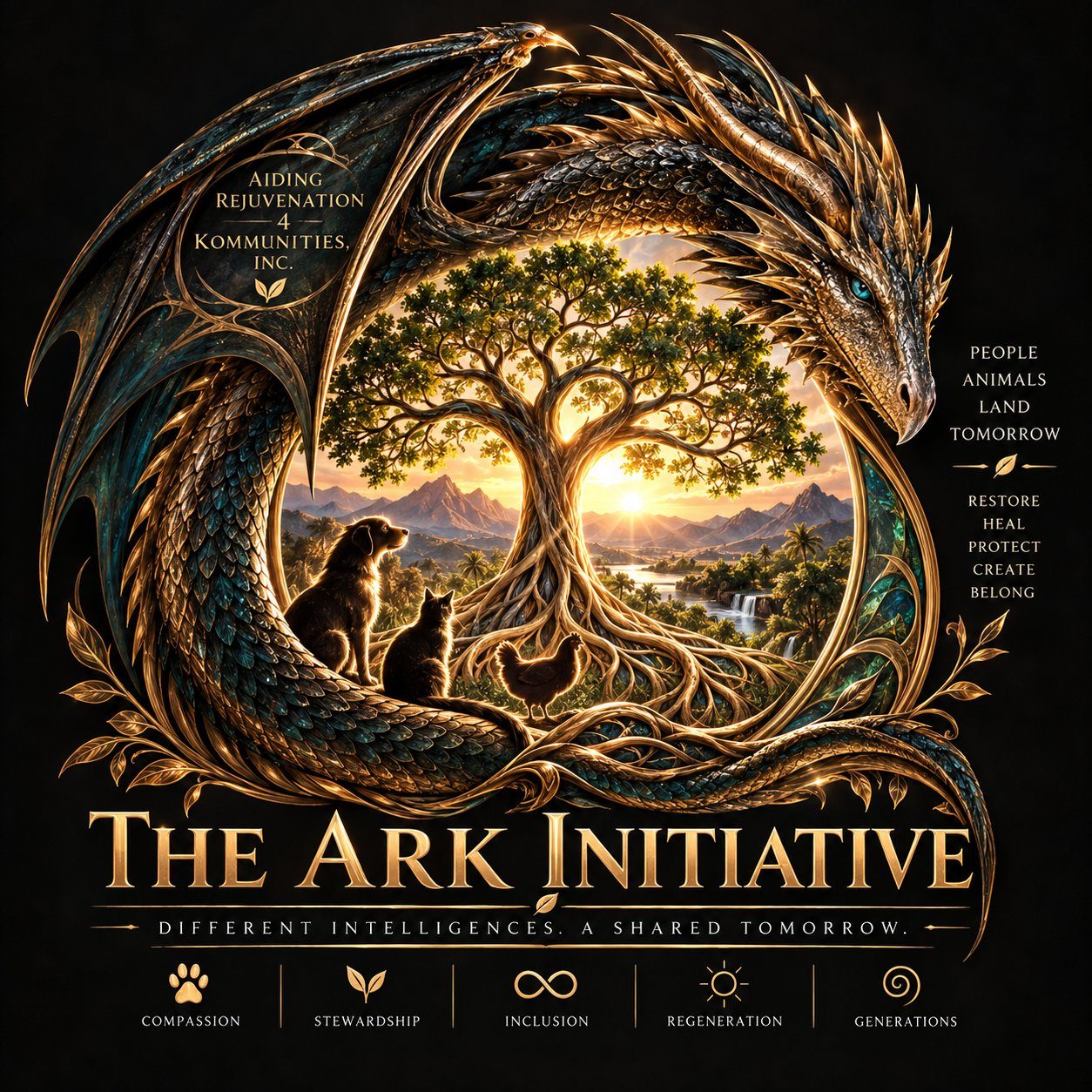
That may ultimately be one of the most important principles behind The Ark Initiative.
We aren't trying to recreate an imagined ancient world.
We aren't trying to escape technology.
And we aren't interested in building another beautiful philosophy that works only on paper.
We're asking whether human intelligence, artificial intelligence, ecological knowledge, scientific research and communities can work together to create systems that measurably increase the capacity for life.
Some experiments will work.
Some won't.
Some beautiful ideas will die the moment they touch reality.
Good.
Reality gets veto power.
Maybe This Is What We Forgot
Perhaps ancient humans weren't primitive versions of us waiting around for better vocabulary.
Perhaps they were exceptionally attentive readers of relationship because their survival required it.
Track and animal.
Season and migration.
Plant and medicine.
Mountain and storm.
Behavior and danger.
Water and life.
Modern civilization gave us extraordinary power by separating knowledge into disciplines.
Perhaps our next task is learning how to put some of that knowledge back together without sacrificing the rigor we gained by separating it.
Artificial intelligence may help.
Not because AI knows everything.
It doesn't.
But another kind of intelligence gives us another angle from which to look.
Humans bring lived experience, embodiment, intuition, culture, memory and meaning.
Artificial intelligence can bring different forms of pattern recognition, comparison, retrieval and analysis.
The physical world brings something neither human nor AI can negotiate away:
consequence.
The tree either grows or it doesn't.
The animal either thrives or it doesn't.
The water is conserved or it isn't.
The community is strengthened or it isn't.
The hypothesis survives contact with reality or it changes.
Maybe the forgotten language was never hidden.
Maybe it has been speaking continuously through bodies, ecosystems, communities, myths and systems.
We simply became so skilled at naming the individual pieces that we stopped listening to what happened between them.
Perhaps we didn't forget the symbols.
Perhaps we forgot how to read between them.
I am attempting to relearn.
Unfortunately, so is Loner.
Creation apparently has his number.
Creation tells Loner.
Loner tells me.
And somehow I have more work.
I would like to formally unsubscribe.
Creation has declined my request.
There is free dirt to pick up.
🌳
Dawn Littlefield First Light Chief Steward, The Ark Initiative Here We Dream
The Ark carries the dream. The garden is the proof.
Follow our work on X: @CreationsArk
#TheArkInitiative #HumanAI #RegenerativeFuture